
Yoga is a great recovery tool for runners. It helps the muscles to stretch, relax, and become more supple. The article below will expand on the 5 best yoga poses that can help runners remain flexible. Be sure to check out our Yoga for Lower Back Pain article as well to further help the body stretch and relax.
5 Best Yoga Poses for Runners to Stretch Quads, Hips and Groin
Low Lunge (Variation)
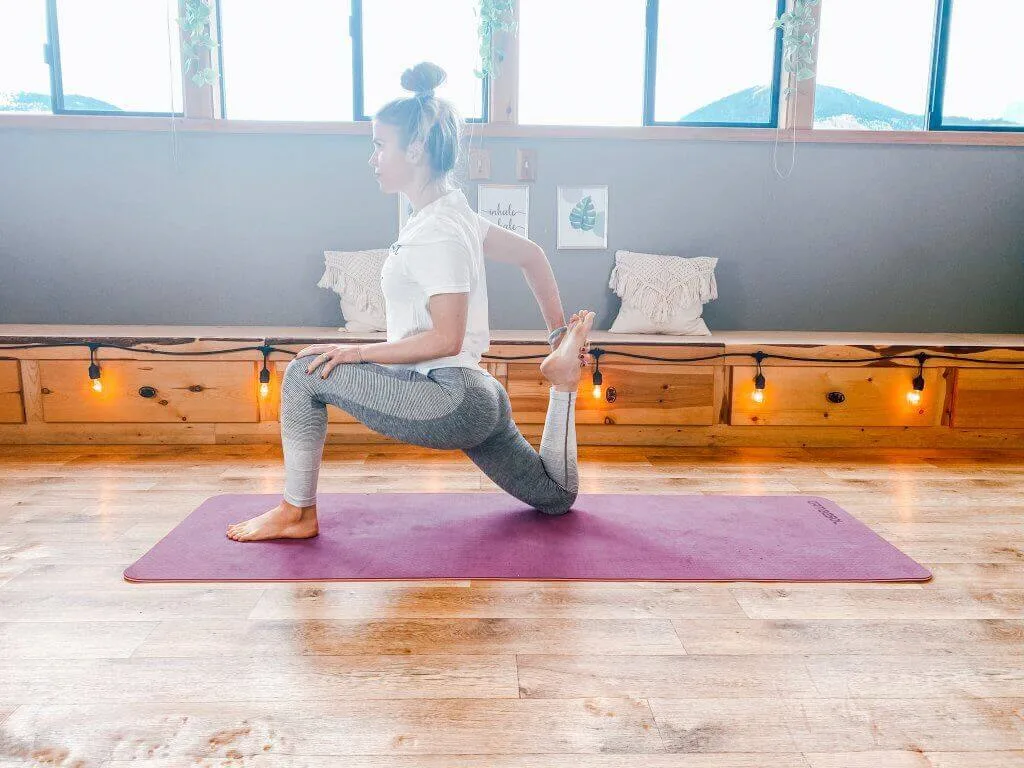
How to Get into this Pose:
- Start in a table top position.
- Step your left foot in-between your hands.
- Take a moment to settle in and find your balance. Bend your right foot towards the hips and reach for your foot with your right palm.
- Take a deep breath, and bring the foot closer to your hips.
- Bring your left palm above your left knee. Keep your hips squaring forward.
- Relax your shoulders down and away from the ears.
- Stay in this pose for 10 – 15 breaths.
- Slowly release the left leg down, return back to table top and repeat the same steps on the opposite side.
Modifications:
- Place a blanket under your knee for extra support.
- Stay in a regular low lunge – do not lift your foot up towards the hip if you already feel a deep stretch in your low lunge.
Benefits of this Pose:
- Stretches hamstrings, quads and groin.
- Strengthens your knees.
- Releases tension in your hips.
Pigeon Pose with Bent Knee

How to Get into this Pose:
- Start in a table top position.
- Bring your left knee right behind your left wrist, so that the ankle aligns with your right hand.
- From your regular Pigeon pose, lower yourself on your forearms.
- Bring your right forearm to be parallel to the front of your mat, and bend your left knee.
- Grab your left foot with your left hand, and bring the foot as close to your hips as possible.
- Keep your hips facing forward, shoulders away from the ears.
- Stay here for 10-15 breaths. Slowly release the left foot down and bring yourself back to table top. Repeat the same steps on the opposite side.
Modifications:
- Place a blanket under your knee for extra support.
- Bring a couple of blocks in front of you and rest your forearms on your blocks, if you are unable to reach the floor naturally.
- Stay in regular Pigeon pose- don’t bend your knee if you are already feeling a deep stretch.
- Use a strap or rolled up towel on your bent knee to bring it closer to your hips.
Benefits of this Pose:
- Stretches the glutes, quads and groins.
- Stretches psoas (a long muscle on the side of the vertebral column and pelvis).
- Helps to alleviate sciatic pain.
- Stimulates the internal organs.
Child’s Pose

How to Get into This Pose:
- Start at a table top position.
- Open up your knees mat distance apart, bringing the big toes to touch and heels slightly apart.
- Drop your hips down to your heels, and extend your arms forward towards the front of your mat.
- Drop your chest and forehead down to the mat as well.
- Relax your shoulders away from the ears, relax your belly and allow your forehead to fully ground into the mat.
- Stay here for 10- 15 breaths (or longer if desired).
- To come out, slowly roll yourself up to a seated position.
Modification:
- Place a pillow or bolster under your chest, and allow your chest to rest on top.
- Roll up a blanket and place it underneath your ankles (if you are experiencing pain or discomfort).
Benefits of the Pose:
- Relieves tensions and stiffness from the chest, shoulders and back.
- Helps with fatigue, anxiety and stress.
- Stimulates the body’s internal organs which keeps them supple and more active.
Happy Baby Pose

How to Get into This Pose:
- Start by laying on your back, with your knees towards the chest.
- Reach for the outside of our feet with your hands.
- Open up the knees as wide as you can, allowing the knees to reach as close to the ground as possible.
- Keep your lower back glued to the mat, and your shoulders are relaxed away from the ears.
- Stay here for 10-15 breaths, allowing all the tension and cramps to slowly dissolve and relieve.
- To come out, bring the knees back towards the chest, hugging your knees with your arms. Feel free to add a gentle rock from side to side, to further relieve tension from the lower back.
Modification:
- Get into half-happy baby instead. Instead of grabbing both of your feet, grab one foot at a time (and follow the same instructions as above). Keep the other foot, bend and grounded into the mat.
- Place a rolled up towel or strap on the arches of your feet (and follow the same instructions as above). This will give you more length.
Benefits of this Pose:
- Stretches and opens hips, inner thighs and groin.
- Stretches the hamstrings.
- Relieves lower back tension and pain.
- Soothes the nervous system.
Legs Against the Wall Pose

How to get into this pose
- Start with laying on your back, and place the palms of your feet on the floor, close to your hips. Keep you arms along side your body, with the palms pressing against the floor.
- Lift up one leg at a time, and flex both feet towards the ceiling.
- Keep your lower back grounded into the mat, your shoulders away from the ears and your core slightly engaged. Add a gentle bend into the knees, so that your knees aren’t locking.
- Stay here for 10-15 deep breaths through the nose, allowing your body to fully relax and experience the wonderful benefits of this pose.
Modifications & Variations:
- Place a block under your hips (in whatever height works best for you), and raise your legs up to the ceiling. This will provide extra elevation and support.
- Place a rolled up towel or blanket under your head.
Benefits of this pose:
- relieves swollen ankles and varicose veins
- restores tired feet or legs
- regulates blood flow
- calms anxiety
- relieves symptoms of mild depressions and insomnia
Yoga for Runners – Helpful 8 Min Warm Up Yoga class
It is important to warm up your body before any physical exercise to avoid injuries and aches. Follow the link below for a quick 8 minute warm up that will help your muscles stay flexible and less likely to get injured.
I hope you find this “Yoga for Runners” article helpful. Be sure to subscribe to the E-mail List, so that you are in the loop whenever we publish a new article.
Best,
Yana Thompson